
The standard answer is twenty percent of your income. It is a reasonable target and a poor starting point.
Poor because for a lot of people, twenty percent is not currently possible. Being told to save an amount you cannot save is a good way to give up on saving entirely.
A better question is what rate is right for your situation, and what to do when the right rate is out of reach today.
Why the Rate Matters More Than the Return
Most financial coverage focuses on returns. Which fund, which account, which strategy.
Early on, that focus is misplaced.
Consider someone with $5,000 saved. A brilliant year returning 15 percent instead of a mediocre 5 percent earns them an extra $500. Saving an additional $200 a month over that same year adds $2,400.
The contribution outweighs the return by nearly five to one.
This flips eventually. Once the balance is large, returns dominate and contributions matter proportionally less. But that crossover takes years to arrive, and until it does, the amount you put in is the variable that actually moves the number.
Your savings rate is also something you control directly. Returns are not.
The Percentage Answers
Here is the range, honestly stated.
Ten percent is a reasonable floor if you are starting out or your income is tight. It builds the habit and produces meaningful results over a long horizon.
Fifteen to twenty percent is the standard recommendation for someone on track for a conventional retirement timeline.
Twenty-five percent or more is territory for people who started late, want to retire early, or have irregular income and need larger buffers.
The widely cited 50/30/20 framework puts half of take-home pay toward needs, thirty percent toward wants, and twenty percent toward saving and debt repayment. It is a useful sanity check rather than a rule — in expensive housing markets the needs portion often exceeds fifty percent through no fault of the person budgeting.
What Time Actually Does
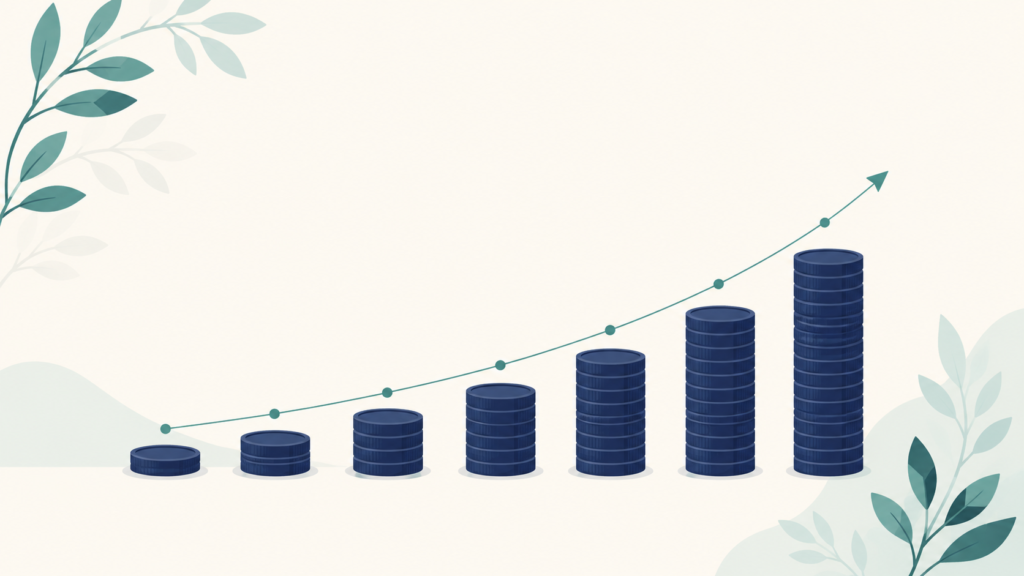
The reason these percentages matter is compounding, and compounding is genuinely difficult to intuit.
Take $500 a month at a 7 percent annual return.
- After 10 years: around $87,000, of which $60,000 came from you
- After 20 years: around $260,000, of which $120,000 came from you
- After 30 years: around $610,000, of which $180,000 came from you
Look at the last line carefully. Contributions tripled between year 10 and year 30. The balance grew sevenfold.
Most of that final figure was never deposited by anyone. It was produced by returns compounding on earlier returns, and it required nothing except time.
A useful shortcut is the Rule of 72: divide 72 by your annual return to estimate how many years it takes money to double. At 7 percent, roughly ten years. At 4 percent, roughly eighteen.
Order of Operations
Before settling on a percentage, it helps to know where the money should go first. The sequence matters more than the amount.
1. Employer match. If your employer matches 401(k) contributions, contribute at least enough to capture the full match. This is an immediate return on your money that no investment will beat. Skipping it is declining part of your compensation.
2. A starter emergency fund. Roughly one month of essential expenses, so that the next surprise does not land on a credit card. We cover the reasoning in how much you should have in an emergency fund.
3. High-interest debt. Anything above roughly 8 percent should be cleared before additional saving. Credit card debt at 22 percent costs far more than any savings account or reasonable investment return will pay. If rates are the obstacle, negotiating them down is often worth attempting first.
4. The full emergency fund. Three to six months of essentials, in a high-yield savings account.
5. Everything else. Retirement accounts beyond the match, then taxable investing, then specific goals.
Working the list in order matters more than hitting any particular percentage. Someone saving 10 percent in the right order will finish ahead of someone saving 20 percent in the wrong one.
If Twenty Percent Is Impossible
For many households it currently is. Housing costs alone can consume half of take-home pay, and that is a structural problem rather than a personal failing.
What works in that situation:
Start at whatever is genuinely sustainable. Two percent is not nothing. Two percent that continues for five years beats twenty percent abandoned after two months.
Increase with income rather than through restriction. Commit in advance to directing half of any raise to saving. This works because the money never enters your spending baseline, a mechanism we cover in why a raise never feels like enough.
Redirect cleared debt payments immediately. When a balance is gone, send that exact amount to savings the same month. You have already adjusted to living without it.
Direct windfalls whole. Tax refunds, bonuses, gifts. These arrive outside your normal budget, so saving them costs nothing in daily terms.
Make It Automatic
This is the part that determines whether any of the above happens.
Set the transfer for the day after payday. Not the end of the month, when saving becomes whatever survived spending — the day after money arrives, before it becomes available for anything else.
The reason automation works so well is that it removes the monthly decision. Every time saving requires an active choice, it competes against everything else you could do with that money, and it will lose more often than you would like.
Automated saving does not require discipline every month. It requires one decision, once.
Where Saving Stops Being the Answer
One honest limitation.
Once your emergency fund is complete, high-interest debt is cleared, and you are still saving consistently, cash in a savings account stops being the right destination. Over long periods, inflation erodes purchasing power faster than savings interest replaces it.
Money you will not need for a decade or more belongs in investments, not savings. That is a different set of decisions with different rules, and it deserves proper attention rather than a paragraph here.
But the sequence holds: cover contingencies first, clear expensive debt, then think about growth.
The Bottom Line
Aim for 15 to 20 percent if you can. Start at 10 if that is more realistic. Start at 2 if that is what is genuinely available.
Follow the order — match, starter fund, expensive debt, full fund, then everything else.
Automate the transfer so it stops being a monthly decision.
And raise the rate when your income rises rather than by squeezing a budget that is already tight. That is the increase most people can actually sustain.
Browse our other topics on the Explore BlurbMoney page.