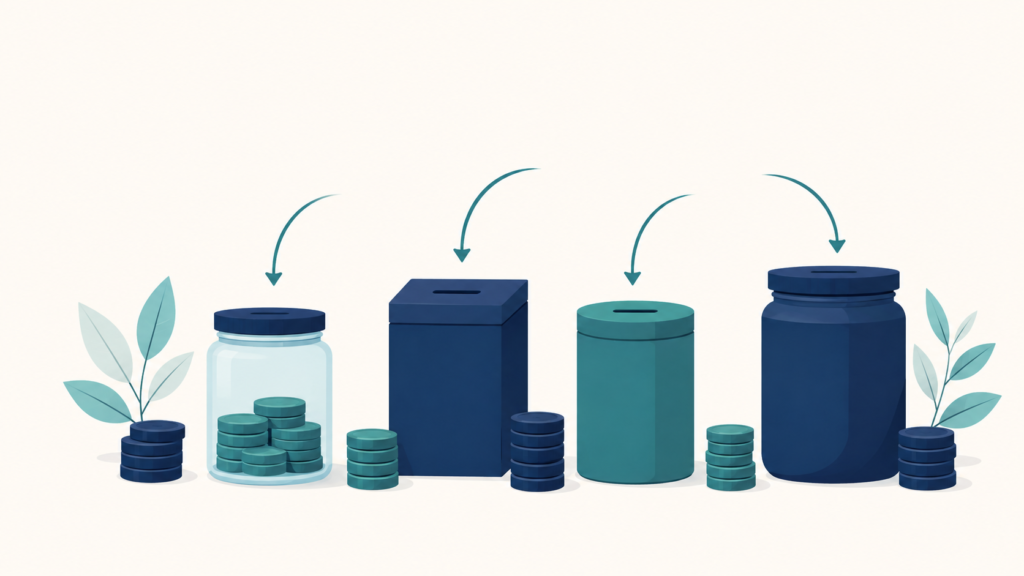
Once you have decided how much to save, the next question is where to put it.
This sounds like a small detail. It is not. The wrong account can cost you hundreds of dollars a year in lost interest, or lock up money exactly when you need it.
The good news is that the choice is simpler than it looks. There are really only four or five options worth considering, and each one suits a different kind of money.
Start With the Question Behind the Question
Before comparing accounts, be clear about what the money is for.
Three things matter:
- When will you need it? Next month, next year, or in five years?
- How quickly must you reach it? Same day, or can you wait a week?
- Can it lose value? For most savings, the answer is no.
Money you might need tomorrow belongs somewhere different from money earmarked for a house deposit in four years.
Regular Savings Accounts
The account your bank opened alongside your checking account.
It is convenient, it is safe, and it pays almost nothing. Large national banks have historically paid a small fraction of a percent on standard savings.
On $10,000, that difference is real money. A rate of 0.01 percent earns you a dollar a year. A competitive rate earns considerably more.
There is one good reason to keep a regular savings account: instant transfers to your checking at the same bank. Beyond that, it is the wrong home for meaningful savings.
High-Yield Savings Accounts
This is where most people’s emergency fund should live.
A high-yield savings account works exactly like a regular savings account. You can withdraw whenever you want. Your balance cannot fall. Deposits are FDIC insured up to $250,000 per depositor, per bank.
The difference is the rate. Online banks and credit unions typically pay many times what the large national banks offer, because they do not carry the cost of branch networks.
The tradeoffs are modest. Transfers to an external bank usually take one to three business days. There is often no branch to walk into. Some accounts have minimum balance requirements, though many do not.
For an emergency fund, a one to three day transfer window is almost always fine. Genuine emergencies rarely require cash within the hour.
What to look for: a competitive rate, no monthly fees, no minimum balance, FDIC insurance, and a usable mobile app.
What to ignore: promotional rates that drop after three months. Check what the ongoing rate is, not the headline.
Money Market Accounts
A money market account sits between savings and checking.
Rates are usually similar to high-yield savings. The difference is access — many money market accounts come with a debit card or check-writing ability.
That convenience cuts both ways. Easier access means easier spending, which is not what you want from an emergency fund.
Money market accounts suit people who want their cushion reachable without a transfer delay, and who trust themselves not to dip into it. They also often carry higher minimum balances than high-yield savings.
Note that a money market account at a bank is FDIC insured. A money market fund at a brokerage is a different product and is not.
Certificates of Deposit
A CD locks your money away for a fixed term — three months, one year, five years — in exchange for a fixed rate.
The rate is guaranteed for the whole term, which is genuinely useful when rates are falling. The catch is the early withdrawal penalty, typically several months of interest.
CDs are wrong for an emergency fund. The entire point of that money is that you can reach it without penalty.
CDs work well for money with a known date attached. A car purchase eighteen months out. A tuition payment next fall. Money you are certain you will not touch before then.
One approach worth knowing is a CD ladder. You split the money across CDs maturing at staggered intervals, so a portion becomes available regularly while the rest keeps earning the longer-term rate.
Treasury Bills and I Bonds
These are US government securities, bought directly through TreasuryDirect.
Treasury bills are short-term, from four weeks to a year. They are backed by the federal government, and the interest is exempt from state and local income tax — which matters if you live in a high-tax state.
I bonds are designed to keep pace with inflation. The rate adjusts with the consumer price index. They cannot be cashed at all in the first twelve months, and cashing before five years costs you three months of interest.
Both are safe. Neither is right for money you might need next week.
Where Not to Keep Savings
Your checking account. It gets absorbed into everyday spending. This is the single most common mistake.
The stock market. Stocks can fall 20 or 30 percent in a matter of weeks. Emergencies have an unfortunate habit of coinciding with downturns — job losses cluster in recessions.
Cash at home. It earns nothing, it is not insured, and it is vulnerable to theft and fire.
Crypto. The volatility is the opposite of what savings require.
A credit card as a substitute. Available credit is not savings. Our comparison of personal loans and credit cards shows how quickly borrowing in a crisis compounds.
A Simple Structure That Works
Most people do well with three accounts:
Checking — one month of expenses, for bills and daily spending.
High-yield savings — your emergency fund, three to six months of essentials. Held at a different bank from your checking, so it takes a deliberate action to reach.
A goal account — for specific targets with dates attached. A CD if the date is fixed, a second high-yield account if it is flexible.
Beyond that, money intended to grow over many years belongs in investments rather than savings. That is a different conversation with different rules.
If you have not yet worked out how much belongs in each, start with how much you should have in an emergency fund.
What About Paying Off Debt First?
If you are carrying credit card debt at 20 percent or more, no savings account will out-earn it. Clearing that debt is mathematically the better return.
The exception is the starter fund. Keep one month of essentials accessible while you pay down debt, so the next surprise does not go straight back on the card.
Our guide to building an emergency fund while paying off debt covers how to divide your monthly surplus. And if high rates are the obstacle, it is often worth negotiating them down first.
How to Actually Switch
Opening a high-yield savings account takes about fifteen minutes online.
You will need your Social Security number, a government ID, and the routing and account numbers for the checking account you will link.
Once it is open, move the money across and set up an automatic transfer for payday. Automation is what makes saving consistent — you are far less likely to skip a month you never had to think about.
One caution: opening a savings account does not affect your credit score, since banks typically use a soft inquiry. Applying for a checking account with overdraft can be different. If you are preparing for a mortgage or auto loan, our guide to improving your credit score before applying is worth reading first.
The Bottom Line
For an emergency fund, a high-yield savings account at a bank separate from your checking is the right answer for most people.
For money with a fixed date, consider a CD or Treasury bills.
For long-term growth, savings accounts are the wrong tool entirely.
The account matters less than the habit. An emergency fund earning a poor rate still beats no emergency fund at a great one.
Browse our other topics on the Explore BlurbMoney page.
Pingback: Investing vs. Speculating: What's the Difference? - BlurbMoney
Pingback: Inflation: What It Actually Does to Your Money - BlurbMoney
Pingback: Bonds Explained — And Why Rising Rates Aren't the Problem - BlurbMoney