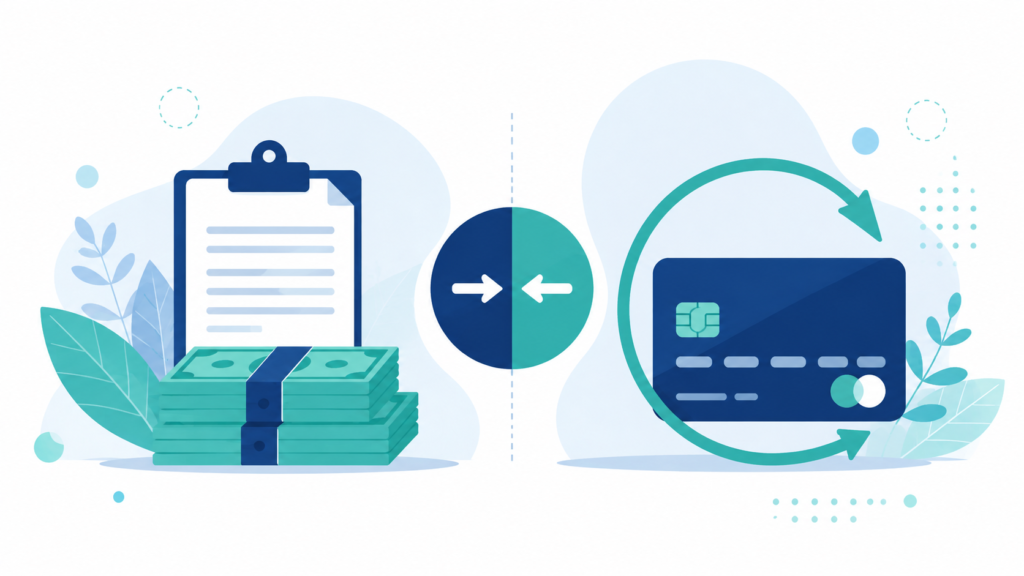
If you’re trying to pay off debt or cover a large expense, you’ve likely considered both a personal loan and a credit card as options. They can serve similar purposes, but the way they work — and what they cost you — is quite different. Here’s how to think through which one actually fits your situation.
How Personal Loans Work
A personal loan gives you a lump sum upfront, which you repay in fixed monthly installments over a set term — typically 2 to 7 years. The interest rate is usually fixed, meaning your payment stays the same for the life of the loan, making it predictable and easy to budget around.
How Credit Cards Work
A credit card gives you a revolving line of credit you can borrow against repeatedly, up to your limit, as long as you make at least the minimum payment. Interest rates are usually variable and significantly higher than personal loan rates, and if you only pay the minimum, the payoff timeline can stretch for years while interest compounds.
Interest Rates: The Biggest Difference
This is usually the deciding factor. Personal loan rates typically range from around 7% to 25% APR depending on credit, while credit card APRs commonly sit between 20% and 30%. For any significant balance, that gap adds up fast — a $10,000 balance at 24% APR costs meaningfully more in interest than the same amount at 12% through a personal loan.
When a Personal Loan Makes More Sense
- You’re consolidating existing high-interest debt — moving multiple credit card balances into one fixed-rate loan is one of the most common and effective uses of a personal loan. See our complete guide to debt consolidation loans for a full breakdown.
- You want a fixed payoff date — a personal loan forces discipline by design, since the term is set in advance.
- You’re borrowing a large, one-time amount — a major expense or debt payoff is usually cheaper through a loan than a card once the balance is significant.
When a Credit Card Makes More Sense
- You can pay off the balance quickly — if you’re confident you can repay within a few months, a card’s flexibility may outweigh the higher rate, especially with a 0% APR introductory offer.
- You need ongoing access to credit — a revolving line is more useful than a lump-sum loan if your borrowing need is recurring rather than one-time.
- You want to build credit history — responsible card use, kept well below your limit, is one of the more common ways to build a credit profile over time.
What About Your Credit Score?
Both options involve a hard inquiry when you apply, causing a small temporary dip. Beyond that, they affect your score differently: a personal loan is installment credit and doesn’t factor into your credit utilization ratio, while a credit card balance does — meaning carrying a high card balance can hurt your score more directly than an equivalent personal loan balance. For a deeper look at this, see our guide on how debt consolidation affects your credit score.
Qualifying for Either Option
Your approval odds and rate for both depend heavily on your credit profile. If you’re not sure where you stand, start with our guides on reading your credit report and improving your credit score before applying. If your credit needs work, our guide on getting a personal loan with bad credit covers realistic paths forward, and secured vs. unsecured loans explains an alternative route that may offer better terms.
Already Have Debt on Both?
If you’re carrying balances across multiple cards and loans already, the choice isn’t really “loan vs. card” anymore — it’s about which payoff strategy gets you out of both fastest. Our comparison of the debt snowball vs. debt avalanche methods can help you build a plan, and it’s also worth trying to negotiate a lower rate on existing balances before taking on anything new.
The Bottom Line
For most people carrying a meaningful balance, a personal loan is the cheaper, more disciplined option due to its lower fixed rate and set payoff date. A credit card makes more sense for smaller, short-term borrowing you’re confident you can repay quickly. Whichever you choose, make sure you’ve built at least a small emergency fund first, so an unexpected expense doesn’t force you to lean on high-interest credit again.
Pingback: Where to Keep Your Savings - BlurbMoney