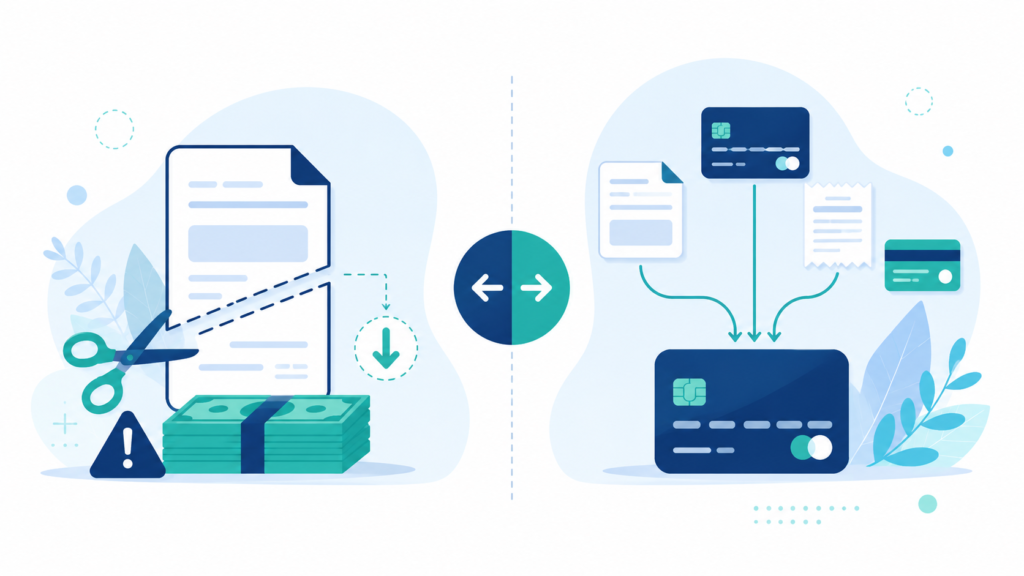
When debt feels unmanageable, two strategies often come up: debt settlement and debt consolidation. They sound similar and are sometimes confused for one another, but they work in fundamentally different ways — one restructures how you repay what you owe, the other negotiates to pay less than the full amount. The right choice depends heavily on your situation, and the wrong choice can do real damage to your credit.
What Is Debt Consolidation?
Debt consolidation combines multiple debts into a single new loan or payment, ideally at a lower interest rate. You still repay the full amount you owe — the benefit is a simpler, often cheaper way to pay it off. For a full breakdown, see our complete guide to debt consolidation loans.
What Is Debt Settlement?
Debt settlement involves negotiating with your creditors (often through a settlement company, though you can do it yourself) to pay less than the full balance owed — typically 40-60% of the original amount — in exchange for the creditor agreeing to consider the debt resolved.
To get creditors to negotiate, most settlement programs have you stop making payments and instead deposit money into a dedicated savings account until you have enough to offer a lump-sum settlement. This is where things get risky.
The Real Cost of Debt Settlement
- Your credit takes a serious hit. Missing payments during the settlement process — which is required by most programs — causes significant credit score damage, and settled accounts are marked as “settled for less than owed” on your credit report, which lenders view negatively for years.
- You may face collections or lawsuits. While you’re not paying, creditors can still send your account to collections or, in some cases, sue you for the full amount before a settlement is reached.
- Settlement isn’t guaranteed. Creditors aren’t obligated to negotiate, and some refuse entirely, leaving you with missed payments and no resolution.
- The forgiven debt may be taxable. The IRS generally treats forgiven debt over $600 as taxable income, meaning you could owe taxes on the amount that was “saved.”
- Fees add up. Settlement companies often charge 15-25% of the enrolled debt as a fee, which can offset a meaningful portion of what you save.
The Real Cost of Debt Consolidation
By comparison, debt consolidation is far gentler on your credit. You continue making payments on time (just to one lender instead of several), so there’s no required missed-payment period. As covered in our guide on how debt consolidation affects your credit score, most people see a small temporary dip followed by steady improvement — the opposite trajectory of settlement.
When Debt Settlement Might Make Sense
Settlement is generally considered a last resort, appropriate mainly when:
- You’re already severely behind on payments and heading toward default or bankruptcy regardless
- Your debt-to-income ratio makes any repayment plan, including consolidation, unrealistic
- You’ve explored consolidation and other options and genuinely cannot qualify or afford them
When Debt Consolidation Is the Better Choice
For most people who are current on payments (or only slightly behind) and have reasonable credit, consolidation is the safer, less damaging path. It preserves your credit standing, avoids the tax complications of forgiven debt, and doesn’t carry the same risk of lawsuits or collections during the process.
Other Options Worth Considering First
Before choosing either path, it’s worth exhausting less drastic options. If your rates are simply too high, try negotiating a lower interest rate directly with your creditors — a much lower-risk conversation than settlement. If you’re managing several balances, comparing the debt snowball vs. debt avalanche methods might make your existing payments more manageable without needing to consolidate or settle at all.
Check Your Credit Standing First
Whichever direction you’re leaning, it helps to know exactly where you stand. Review our guides on reading your credit report and improving your credit score before making a decision that will affect your credit for years.
The Bottom Line
Debt settlement can reduce what you owe, but it does so at a steep cost to your credit, with real legal and tax risks along the way. Debt consolidation costs you the full balance but protects your credit and avoids those risks entirely. For the vast majority of people still able to make payments, consolidation is the more prudent path — settlement should generally be reserved for situations where default is otherwise unavoidable.
Pingback: What Happens If You Stop Paying Your Credit Card Debt? - BlurbMoney