
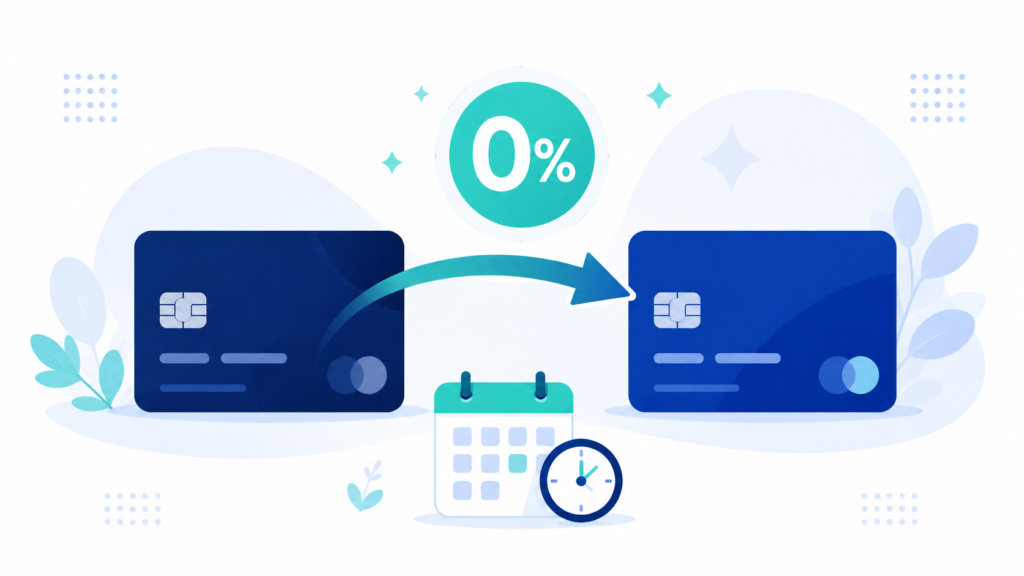
A 0% APR balance transfer card lets you move existing credit card debt onto a new card and pay no interest for a set promotional period — often 12 to 21 months. Used well, it can save you hundreds or thousands of dollars in interest. Used carelessly, it can leave you in a worse position than when you started.
How Balance Transfer Cards Work
You apply for a card offering a 0% introductory APR on transferred balances. Once approved, you move your existing high-interest debt onto the new card. For the length of the promotional period, you owe no interest on that balance — every payment you make goes directly toward the principal.
After the promotional period ends, any remaining balance starts accruing interest at the card’s standard APR, which can be quite high — sometimes 20% or more.
The Balance Transfer Fee
Almost all balance transfer cards charge a fee, typically 3-5% of the amount transferred. On a $5,000 transfer, that’s $150-$250 charged upfront, added to your new balance. This fee needs to be factored into whether the transfer actually saves you money compared to what you’d pay in interest otherwise.
Do the Math Before You Transfer
Say you have a $5,000 balance at 22% APR, and you’re paying it off over 18 months. Left where it is, you’d pay roughly $900-$1,000 in interest over that time. Transfer it to a 0% APR card for 18 months with a 3% transfer fee ($150), and you’d pay just that $150 flat — a meaningful savings, as long as you pay it off before the promo period ends.
The math only works in your favor if you can realistically pay off the balance within the promotional window. If you can’t, you may end up paying the transfer fee on top of standard interest anyway.
Common Mistakes That Cost People Money
- Missing the payoff deadline: If any balance remains when the promo period ends, it starts accruing interest at the standard rate — sometimes retroactively, depending on the card’s terms.
- Making a late payment: Many cards will revoke your 0% promotional rate immediately if you miss even one payment, reverting to the standard APR on your full balance.
- Using the new card for new purchases: New purchases often don’t qualify for the 0% rate and may start accruing interest immediately, while your payments are applied to the 0% balance first — leaving new purchase interest to pile up.
- Not qualifying for the full amount: Your approved credit limit may be lower than the balance you want to transfer, especially if your credit isn’t strong.
Who Balance Transfers Work Best For
This strategy works best if you have good to excellent credit (needed to qualify for the best offers), a clear plan to pay off the balance within the promotional window, and the discipline to avoid running up new debt on either card. If any of those don’t apply to you, it’s worth weighing other options.
Balance Transfer vs. Debt Consolidation Loan
Balance transfer cards and debt consolidation loans solve a similar problem in different ways. A balance transfer card offers 0% interest but only temporarily, and typically only makes sense for a single card’s balance within your credit limit. A debt consolidation loan offers a fixed rate for a longer term and can combine multiple debts — including ones larger than a single card’s limit — into one predictable payment. If your debt is spread across several accounts or exceeds what a balance transfer card could realistically cover, consolidation is often the more practical route.
Checking Your Eligibility First
The best balance transfer offers go to borrowers with strong credit. Before applying, it’s worth reviewing our guides on reading and understanding your credit report and improving your credit score before applying for a loan. If your credit isn’t there yet, our guide on getting a personal loan with bad credit covers alternative paths, and secured vs. unsecured loans explains another route that may be more accessible.
The Bottom Line
A 0% APR balance transfer card can be one of the most effective tools for paying off high-interest debt quickly — but only with a firm payoff plan and the discipline to stick to it. If you’re weighing this against other payoff strategies, our comparison of the debt snowball vs. debt avalanche methods, or checking how long negative information stays on your credit report if you’re recovering from past missteps, can help you build a complete plan. And if you consolidate instead, see how it may affect your score in our guide on how debt consolidation affects your credit score.
Pingback: How to Negotiate a Lower Interest Rate on Your Debt - BlurbMoney
Pingback: Personal Loan vs. Credit Card: Which Is Better for Debt Payoff? - BlurbMoney