Financial mistakes are not usually caused by a lack of information.
Most people know that credit card interest is expensive. Most people know they should save more. The knowledge is rarely the problem.
The problem is that money decisions are made by human beings, and human beings did not evolve to think in spreadsheets. We evolved to react quickly, avoid loss, and follow the group.
Those instincts served us well for most of history. They serve us badly at a bank.
Understanding why is more useful than another budgeting tip. Once you can see the pattern, you can build around it.
You Have Two Ways of Thinking
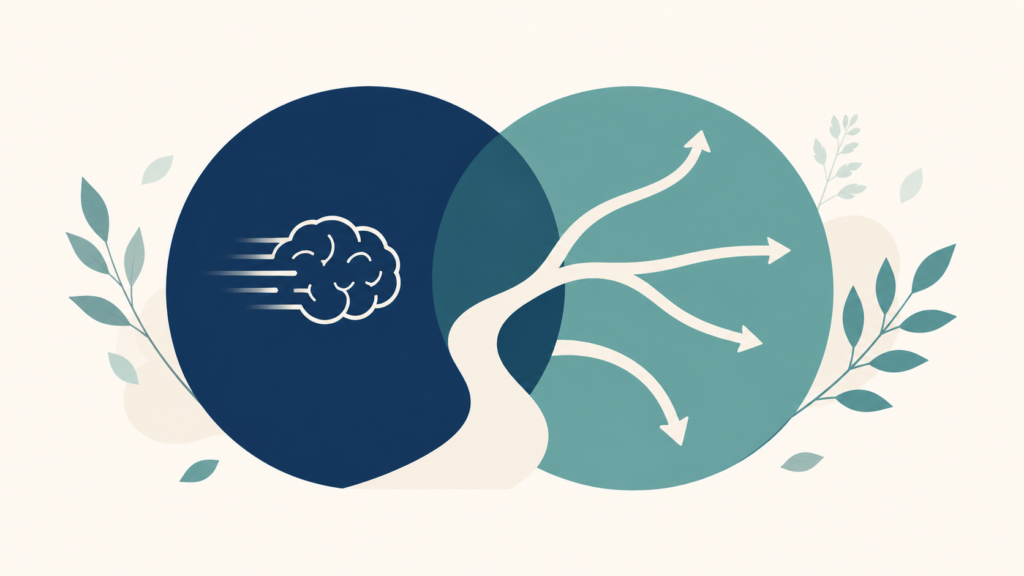
The psychologist Daniel Kahneman won a Nobel Prize partly for describing something most of us sense but rarely name: we think in two different modes.
The first is fast, automatic, and effortless. It works on impressions and gut feel. It is oriented toward immediate action, and it operates whether you want it to or not.
The second is slow, deliberate, and demanding. It works on logic and evidence. It is the mode you use to calculate a loan payment or compare two mortgages.
The fast system runs almost all the time. The slow one is expensive to run, so we use it sparingly.
This matters because most financial decisions get made by the fast system while we tell ourselves the slow one is in charge. You do not calculate whether a purchase fits your goals. You feel like buying it, and then you assemble reasons.
Emotion Is Not the Enemy
The obvious conclusion would be that we should strip emotion out of money decisions entirely. That turns out to be wrong.
The neuroscientist Antonio Damasio studied patients whose brain damage left their reasoning intact but removed their ability to feel. Their logic worked perfectly. Their lives fell apart.
Unable to attach any emotional weight to options, they could deliberate endlessly without ever choosing. Impaired feeling and impaired deciding turned out to go together.
So the goal is not to become emotionless about money. It is to notice when a feeling is doing work it should not be doing.
Four Patterns That Cost You Money
Loss aversion
Losing $100 hurts more than gaining $100 feels good. Considerably more, in most measurements.
This asymmetry drives strange behavior. People hold onto losing investments so the loss does not become real. People avoid a good opportunity because the downside looms larger than the upside.
In everyday finance, it shows up as reluctance to switch accounts, cancel subscriptions, or admit a purchase was a mistake.
Mental accounting
We treat money differently depending on where it came from.
A tax refund feels like a windfall, so it gets spent freely. The same amount earned through overtime feels precious. A dollar is a dollar, but our minds file it in different drawers.
This is why people will carry credit card debt at 22 percent while keeping money in a savings account earning far less. The accounts feel separate. Mathematically, they are not.
The affect heuristic
When we like something, we judge its risks as lower and its benefits as higher. When we dislike it, we do the reverse.
The feeling comes first, and then the risk assessment bends to match. A company you admire feels like a safer investment. A financial product with slick marketing feels less risky than the same product presented plainly.
Social validation
Money decisions are social, whether we admit it or not.
Spending rises to match the people around us. Investment enthusiasm spreads through groups. When everyone agrees something is a good idea, the agreement itself starts to feel like evidence.
It rarely is. As Charlie Munger has pointed out for decades, the collective impact of many people making the same judgment error is a market pushed in a destructive direction.
The Mistake Behind the Mistakes
There is one error that sits underneath most of the others: judging a decision by how it turned out.
The poker player Annie Duke calls this resulting. A good outcome must have followed a good decision, and a bad outcome must have followed a bad one.
In a world with any element of chance, this is simply false.
You can make a careful, well-reasoned financial decision and have it go badly. You can make a reckless one and get lucky. If you only judge by results, you will learn the wrong lessons from both.
Someone who cashes out their retirement account to buy a single stock and doubles their money has not made a good decision. They have had a good outcome. The distinction matters enormously, because the same decision repeated will eventually produce the outcome it deserved.
Duke’s suggestion is to treat decisions as bets. Not because money is a game, but because a bet forces you to ask what you actually believe and how confident you are — before the result is known.
What Actually Helps
Knowing about these patterns does not switch them off. Kahneman himself said as much about his own thinking.
What works better is designing around them.
Automate the decisions you keep getting wrong. A transfer to savings on payday removes the monthly negotiation with yourself. This is the single most effective change most people can make.
Introduce delay. The fast system is oriented toward immediate action. A rule that any purchase above a set amount waits a week gives the slow system time to arrive.
Write down your reasoning before the outcome. Not the decision, the reasoning. When you review later, you can judge the thinking on its own terms rather than through the result.
Make the numbers concrete. Mental accounting weakens when the money is in one place. Knowing your total debt and total savings as single figures is more useful than tracking each account separately. Calculating your debt-to-income ratio is a good place to start.
Reduce the number of decisions. Every choice you have to make is a chance for the fast system to take over. Fewer accounts, fewer subscriptions, and fewer moving parts means fewer opportunities to go wrong.
Where This Shows Up in Practice
These are not abstract patterns. They have specific, expensive consequences.
Loss aversion is why people avoid looking at their credit report — the information might be bad, so it feels safer not to know. Our guide to reading your credit report covers what is actually in there, most of which is less alarming than the anticipation.
Mental accounting is why the debt snowball method works for many people despite the avalanche method being mathematically superior. Paying off a small balance first feels like progress, and that feeling sustains the effort. Our comparison of the two approaches takes this seriously rather than dismissing it.
The affect heuristic is why balance transfer offers work so well. Zero percent feels like free money. Our look at whether these cards are worth it works through what the offer actually costs.
And avoidance generally is why people stop opening statements when things get difficult — which is precisely when opening them matters most. If you have reached that point, our guide to what happens if you stop paying lays out the real consequences without dramatizing them.
The Bottom Line
Intelligence offers surprisingly little protection here. Highly analytical people make these errors too, and sometimes more confidently, because they are better at constructing justifications after the fact.
What helps is accepting that your fast, instinctive system will handle most money decisions whether you like it or not — and building a structure that makes its default choices good ones.
Automate the important things. Slow down the expensive ones. Judge your decisions by your reasoning, not your results.
None of this makes you rational. It makes you slightly less exposed to being irrational, which is the realistic goal.
Browse our other topics on the Explore BlurbMoney page.
Pingback: Why Checking Too Often Costs You - BlurbMoney