A bond is a loan. You lend money to a government or a company, they pay you interest for a fixed period, and at the end they return your principal.
That is the whole product. What confuses people is not the bond itself but what happens to its price along the way — and the confusion leads to a conclusion that turns out to be backwards.
Why Prices Move Opposite to Rates
Suppose you buy a bond paying 4 percent.
Six months later, newly issued bonds are paying 5 percent. Nobody will buy your 4 percent bond at what you paid, because they can get a better one. Its market price falls until the lower coupon becomes competitive.
The reverse also holds. If new bonds are paying 3 percent, your 4 percent bond becomes more attractive and its price rises.
Rates up, bond prices down. Rates down, bond prices up. That is the entire mechanism.
Note what has not changed: the bond still pays 4 percent, and still returns your principal at maturity. Only its resale value moved.
Duration: How Much Prices Move
Bonds differ in how sensitive they are to rate changes, and the measure of that sensitivity is called duration, expressed in years.
The rough rule: price change ≈ duration × rate change, in the opposite direction.
A bond fund with a duration of five years will fall roughly 2.5 percent if rates rise by half a percentage point. One with a duration of two years falls about 1 percent on the same move.
Longer duration means more sensitivity in both directions. It is the single most useful number to know about a bond fund, and it is published.
The Part That Sounds Wrong
Financial commentary treats rising rates as unambiguously bad for bond investors. Over a long enough horizon, the opposite is closer to true.
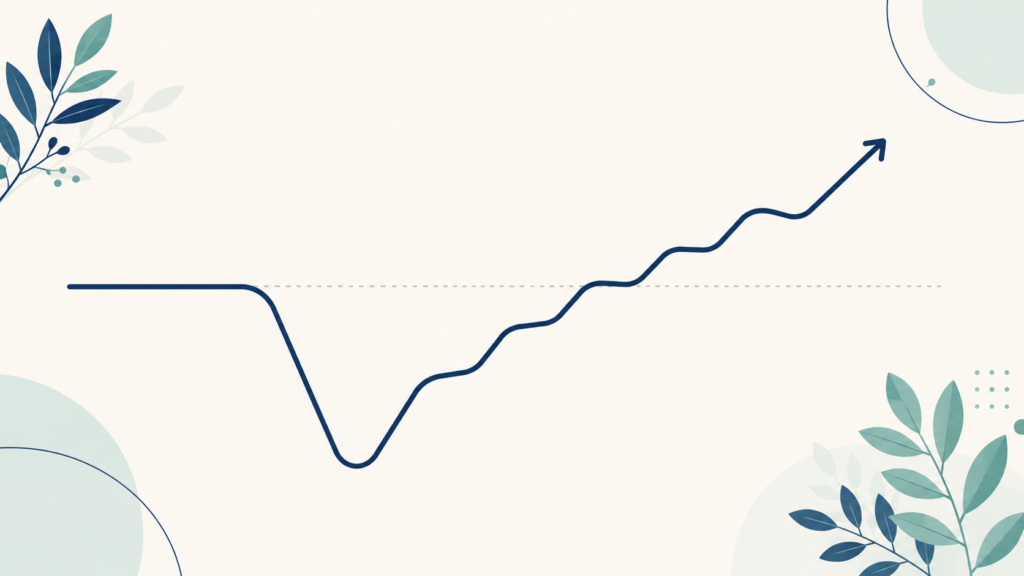
Work through the same example. Your fund has a duration of five years and rates rise half a percentage point. The price drops about 2.5 percent — a real, immediate loss.
But from that moment, the fund is earning half a percentage point more than before. Coupons get reinvested at the higher rate. Maturing bonds are replaced with better-paying ones.
At half a percentage point extra per year, it takes about five years to recover the 2.5 percent — which is the duration.
Sébastien Page, who runs asset allocation at T. Rowe Price, points out that this offset works regardless of the size of the rate move. Bigger shock, bigger price fall, but also bigger reinvestment benefit, arriving over roughly the same period.
Rising rates are bad in the short run and good in the long run. Which one you experience depends entirely on your time horizon.
The Number That Predicts Your Return
This is the most useful thing in the article, and it has no equivalent for stocks.
For high-quality bonds, the yield when you buy is a remarkably good predictor of what you will earn — provided you hold for roughly the fund’s duration.
Research by Justin Harvey and Aaron Stonacek, going back to 1976, tested this across time horizons. The correlation between starting yield and subsequent return exceeded 80 percent for holding periods between half and twice the duration. It peaked around 97 percent when the holding period roughly matched duration.
Their most striking finding: the predictability held equally well whether rates rose or fell over the period.
Page’s summary is worth sitting with. If your horizon is long enough, it does not much matter which way rates go. The starting yield is what matters.
No comparable single indicator exists for stocks. Page notes that this one publicly available number forecasts bond returns more accurately than any model his industry has built for equities.
What This Means Practically
Match duration to your time horizon. If you need the money in three years, a bond fund with a three-year duration is a reasonable fit. A fund with a fifteen-year duration is not — you may be forced to sell during a price drop before the reinvestment benefit arrives.
This is the same principle behind keeping short-term money in cash, covered in where to keep your savings. Match the asset to when you need it.
Check the yield before buying. It is the closest thing to a forecast you will get in investing.
Do not panic when rates rise. If your horizon exceeds the duration, the price fall is temporary and the higher reinvestment rate is permanent. Selling converts a paper loss into a real one and forfeits the recovery.
That instinct is the one we described in Mr. Market — reacting to a price rather than to what you own.
Not All Bonds Are Equal
Two risks, and they behave differently.
Interest rate risk is what we have covered. It affects all bonds and is measured by duration.
Credit risk is the chance the borrower does not pay. US Treasuries carry effectively none. Investment-grade corporate bonds carry a little. High-yield bonds — the ones once called junk — carry considerably more, which is why they pay more.
Credit risk is where bonds stop behaving like bonds. Harvey and Stonacek found starting yield much less predictive for high-yield and emerging market bonds than for high-quality ones.
There is a reason. High-yield bonds behave more like stocks in a downturn — the conditions that hurt company profits are the conditions that make companies default. So the thing you bought partly for stability starts moving with the asset it was meant to diversify, which is the failure described in why diversification works.
Something to Check About Bond Index Funds
A point most consumer coverage misses.
Broad US bond index funds have changed character over time. As companies took advantage of low rates to issue longer-dated debt, the main index’s duration lengthened — meaning more sensitivity to rate moves than the same fund had a decade earlier.
The credit mix shifted too. Page documents that between 2008 and 2020, the share of the very highest-rated corporate bonds in the main US index fell sharply, while lower-rated investment-grade bonds took their place.
The fund kept its name. Its risk profile did not stay the same.
Worth checking your bond fund’s current duration and credit quality rather than assuming it matches what it held when you bought it.
Why Hold Bonds at All
Three reasons, and one that is often overstated.
Predictability. The starting-yield relationship gives you something approaching a known return over a matched horizon. Nothing in equities offers that.
Lower volatility. High-quality bonds move considerably less than stocks, which matters when you are close to needing the money — or close to retirement, as covered in how much you need to retire.
Income. Regular payments, useful for anyone drawing on their portfolio.
The overstated reason is diversification. Bonds usually move differently from stocks, but the relationship is not reliable — a shock to interest rates or inflation can push both down together. That happened in 2018, when both fell. Bonds reduce volatility more dependably than they hedge equity risk.
What About Inflation
Ordinary bonds pay a fixed amount, so inflation erodes what those payments buy. A bond yielding 4 percent during 3 percent inflation earns you roughly 1 percent in real terms — the distinction we drew in what inflation does to your money.
Treasury Inflation-Protected Securities address this directly: the principal adjusts with the consumer price index, so the real return is protected rather than hoped for.
Locking in a low fixed yield for a long period is where inflation does the most damage to a bond holder.
Where Bonds Fit
Same sequence as everything else. Emergency fund, high-interest debt cleared, employer match captured — then investing, as set out in how much you should save each month.
Within a portfolio, the conventional approach increases bonds as your horizon shortens. Decades away, stocks do the work. Close to needing the money, the volatility reduction matters more than the growth.
Target-date funds do this automatically, which is why they are common in workplace retirement plans.
The Bottom Line
A bond is a loan. Its price moves opposite to interest rates, and duration tells you how much.
Rising rates hurt in the short term and help in the long term, because the reinvestment benefit outlasts the price drop.
For high-quality bonds, the yield when you buy is a strong predictor of your return over a horizon matching duration — and that holds whether rates rise or fall.
Match duration to when you need the money. Check what your bond fund actually holds now rather than what it held when you bought it. And do not sell into a rate-driven price fall if your horizon is long enough to collect the recovery.
This article is general information, not personalized investment advice. All investing involves risk, including possible loss of principal.
Browse our other topics on the Explore BlurbMoney page.