If you’re carrying debt across multiple accounts — credit cards, personal loans, store cards — the order in which you pay them off matters more than most people realize. Two strategies dominate the conversation: the debt snowball and the debt avalanche. Both work. The right one for you depends less on math and more on what will actually keep you paying month after month.
What Is the Debt Snowball Method?
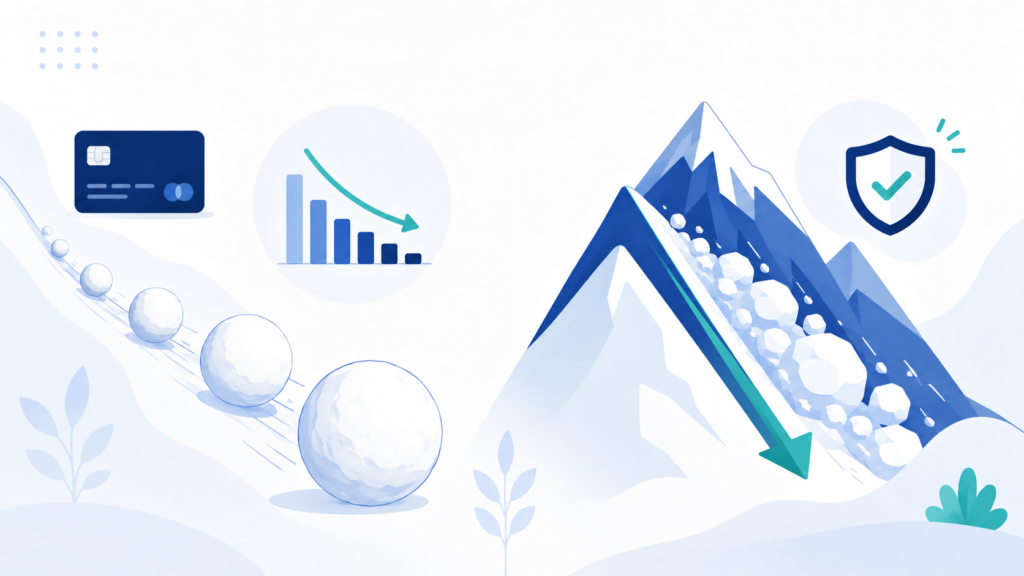
The debt snowball method has you list your debts from smallest balance to largest, regardless of interest rate. You pay the minimum on everything except the smallest debt, which gets every extra dollar you can spare. Once that’s paid off, you roll its payment into the next-smallest debt, and so on — like a snowball picking up size as it rolls downhill.
The appeal is psychological: you get a quick win early, which builds momentum and makes the process feel achievable rather than endless.
What Is the Debt Avalanche Method?
The debt avalanche method instead orders debts from highest interest rate to lowest, ignoring balance size. You throw extra payments at the highest-interest debt first, since that’s the one costing you the most money every month it lingers.
Mathematically, this method almost always saves you more in total interest and gets you debt-free faster, since you’re minimizing the amount of money lost to interest charges along the way.
Snowball vs. Avalanche: A Side-by-Side Example
Imagine three debts: a $1,000 card at 22% APR, a $3,000 loan at 12% APR, and a $6,000 card at 24% APR.
With the snowball method, you’d attack the $1,000 balance first (smallest), then the $3,000 loan, then the $6,000 card last — even though it has the highest rate.
With the avalanche method, you’d attack the $6,000 card first (highest rate at 24%), then the $1,000 card (22%), then the $3,000 loan (12%) last.
The avalanche method will cost you less in total interest over time. But if seeing that $1,000 balance disappear quickly is what keeps you motivated to stay on track, the snowball method’s early win may matter more in practice than the math suggests.
Which Method Should You Choose?
Ask yourself honestly: do you stick with financial plans better when you see fast progress, or are you comfortable playing the long game for maximum savings?
- Choose the snowball method if: you’ve struggled to stay motivated with past debt payoff attempts, or you have several small debts that can be knocked out quickly.
- Choose the avalanche method if: you’re disciplined about sticking to a plan even without early wins, and you want to minimize the total interest you pay.
A Third Option: Debt Consolidation
Both methods assume you’re paying off multiple debts individually. If you’re juggling several high-interest balances, it may be worth exploring whether a debt consolidation loan could simplify things into a single monthly payment — sometimes at a lower overall interest rate than what you’re currently paying across multiple cards.
The Bottom Line
There’s no universally “correct” method — the best debt payoff strategy is the one you’ll actually stick with until your balances hit zero. If you’re unsure, some people even use a hybrid approach: knocking out one or two small debts first for motivation, then switching to the avalanche method for the rest. And whichever method you choose, paying down debt consistently will also help improve your credit score over time, putting you in a stronger position for future borrowing.
Pingback: How to Build an Emergency Fund While Paying Off Debt - BlurbMoney
Pingback: Debt Settlement vs. Debt Consolidation: Which Is Right for You? - BlurbMoney
Pingback: Debt-to-Income Ratio: What It Is and Why It Matters - BlurbMoney
Pingback: Emergency Fund: How Much You Actually Need - BlurbMoney
Pingback: How Long Does Negative Info Stay on Your Credit Report? - BlurbMoney